Choose embroidered patches when a visible stitched texture, a badge-like finish or a planned removable attachment matters most. Choose garment DTF transfers when full-color artwork, gradients or finer printed detail are the priority, particularly for small runs. Compare the actual design, garment, attachment and care requirements before deciding: neither method is always cheaper, faster or more durable.
This guide compares separate embroidered patches with DTF graphics heat-applied directly to a garment. Direct embroidery is another construction: it stitches into the garment itself and does not provide the interchangeable backing choices of a separate patch.
What You Are Buying with Each Method
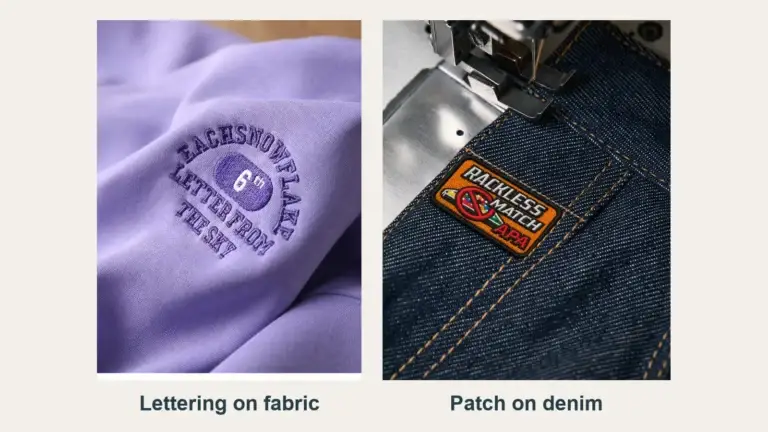
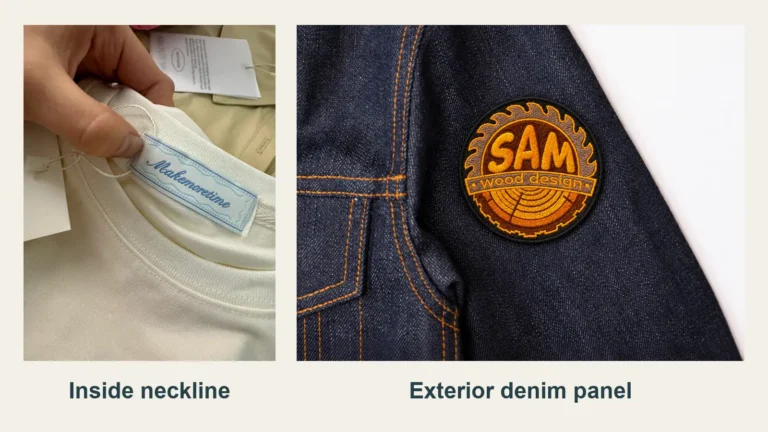
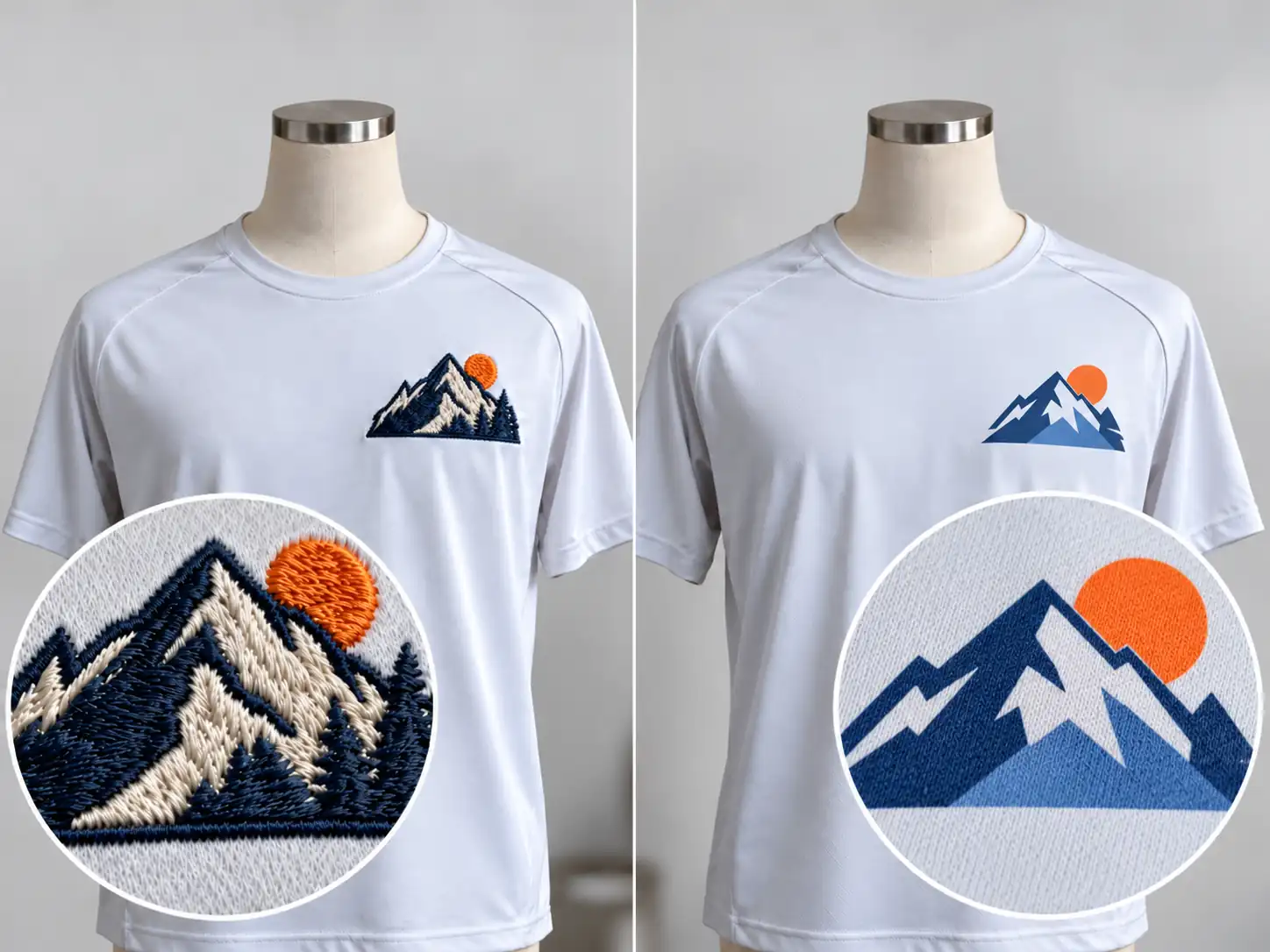
An embroidered patch is a textile emblem made with stitched thread on a supporting construction, then attached to the garment or accessory. The threads give the design visible direction, highlights and relief. The finished edge also helps it read as a distinct badge.
Garment DTF means direct-to-film printing. The design is printed onto transfer film and applied to a suitable textile using an adhesive system and heat. The carrier is removed according to that transfer's instructions, leaving a printed graphic on the garment. This is different from sewing a patch onto the fabric, and from printing a design directly into the garment with a DTG printer.
| Buying priority | Embroidered patches | Garment DTF transfers |
|---|---|---|
| Surface appearance | Visible thread texture and a separate emblem profile | Usually a smoother, lower-profile printed finish |
| Fine artwork | Small details may need simplification at the chosen size | Often better suited to gradients, tonal shading and multicolor illustrations |
| Small-order economics | Digitizing, setup and finishing can make small runs expensive per piece | Can be economical for short runs and complex color artwork; include application costs |
| Attachment | Sew-on, suitable heat-activated backing or a specified hook-and-loop system | Heat application to a compatible, accessible garment area |
| Changing the branding | A hook-backed patch can be exchanged on a compatible, securely attached loop panel | Normally intended to remain in its applied position |
| Wear and laundering | Depends on thread, construction, attachment and actual care conditions | Depends on the transfer system, application, fabric and actual care conditions |
Texture and Detail: Decide What the Design Must Do
When Stitched Texture Adds Value
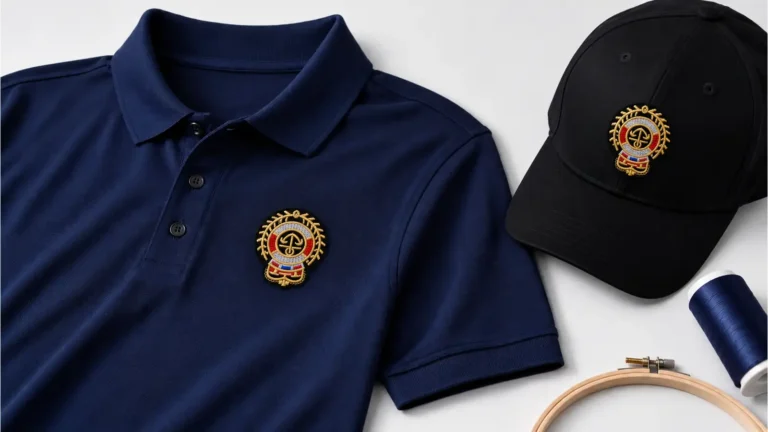
Embroidery suits logos intended to look like a physical emblem: uniform identification, club badges, jacket patches and bag branding. Thread direction can make a simple design feel more substantial without adding more colors or visual detail.
Full embroidery is optional. A deliberately exposed base fabric can be part of a good-looking patch. Adding background stitches solely to pursue a more premium appearance can raise cost without improving the logo's readability or suitability for the garment. The embroidery coverage guide explains how to compare that choice.
That texture also has a physical presence. Check the weight, stiffness, edge and feel on the intended product, especially a light shirt or a stretch garment. A patch that works on a structured jacket may feel different on thin knit fabric.
When Printed Detail Is the Priority
DTF is often the more practical route for photographs, smooth gradients, detailed illustrations and designs with many tonal changes. Stitching translates those features into thread areas and paths; it does not reproduce every pixel as a printed image would. At a small finished size, fine lettering, narrow gaps and closely spaced outlines may need to be enlarged or simplified for embroidery.
Printing still has limits. Tiny isolated marks, very fine lines and small negative spaces must work with the chosen printer, adhesive and transfer process. Ask the transfer supplier to review the artwork at its real output size rather than assuming any screen detail will survive production and use.
Conventional garment DTF generally gives a flatter result than a stitched emblem, but it is not necessarily imperceptible to touch. A large solid print can feel different from an open design with less printed area. Judge the hand feel and flexibility on a sample of the actual garment.
For embroidery, use the artwork preparation guide to identify details that need adjustment before quoting or sampling.

Cost and Production Speed Need an Order-Specific Comparison
Embroidery cost changes with finished size, coverage, stitch work, colors, materials, border, backing and quantity. Fine or complex artwork can add production work, while digitizing and setup are spread across fewer pieces on a small order. These are reasons a low-quantity patch order can cost more per piece than expected.
DTF can offer a lower-cost route for short runs or complex full-color designs because the appearance is created by printing rather than translating all the detail into stitches. However, the price of a loose transfer is not the price of a fully decorated garment. Include artwork preparation, transfer size and layout, garment handling, heat application, packing and delivery on the same basis.
A simple design on a larger repeat order may produce a different cost comparison. Obtain matching quotations rather than assuming DTF is always cheaper or that embroidery is always expensive. If the embroidery version simplifies the original artwork, approve that difference explicitly before comparing the results.
The same caution applies to speed. A ready-to-print DTF design may move quickly through a suitable production workflow; a new embroidered patch may require digitizing and a stitch-out before approval. In either case, artwork corrections, material availability, supplier capacity, sample approval and delivery can determine when the order is ready to use.
Ask for an order-specific schedule that separates sample approval, production, dispatch and receipt. An advertised process speed does not establish the delivery date for your particular garment order.
Backing Changes the Attachment Options
Separate embroidered patches offer several attachment routes, but each solves a different problem:
- Sew-on: attaches the patch mechanically without relying on a heat-activated adhesive bond. The placement must be accessible for sewing, and needle holes must be acceptable.
- Iron-on: uses heat-activated backing on a compatible fabric. Heat tolerance, surface finish, stretch and the actual application process still need checking.
- Hook-and-loop: allows the hook-backed patch to be removed and exchanged on a compatible loop panel. The panel must already exist or be attached securely to the garment.
A stitched patch is not automatically removable. Sewn patches need their stitching removed; heat-bonded patches are not a routine interchangeable system. If the brief requires replaceable names, roles or logos, specify the hook and loop components, their size, placement and attachment before ordering. See the hook-and-loop patch guide for the construction to confirm.
DTF is normally designed as fixed decoration once applied. It does not provide the same everyday swap-in, swap-out function as a patch on a loop panel. Repositionability should not be assumed when planning uniforms or reusable identification.
Fabric Compatibility Is Broader Than a T-Shirt Label
Neither method should be approved from a garment's fiber name alone. Garment DTF systems can serve cotton, polyester and blends when their product specifications permit those materials. Coatings, nylon, high stretch, textured surfaces, dye behavior and heat-sensitive components require particular attention; a product approved for one material is not automatically approved for another.
The transfer area must also be reachable and supported during pressing. A flat shirt front and a coated, assembled bag with seams and linings are different application problems.
An embroidered patch can offer another route through sewing or a properly installed loop panel when direct heat application is unsuitable. That does not make every patch suitable for every surface. Sewing may compromise a waterproof construction, and the patch or attachment may restrict a flexible material. Choose the method and placement around the whole product. The patch backing selection guide explains the attachment choices to review.
Washing and Abrasion: Test the Complete Decoration
It is too broad to describe all DTF as non-washable or all embroidery as permanently wear-resistant. Both the decoration and its attachment have to withstand the intended conditions.
Well-specified embroidery can be a strong choice for frequently worn and washed items. However, exposed threads can snag or abrade, and an otherwise sound patch can fail at its adhesive bond, edge stitching or attachment hardware. Thread type, patch construction and laundering conditions matter alongside the visible texture.
DTF durability depends on the actual ink, adhesive, film and curing system, the substrate, application and care. Poorly matched materials or application can lead to edge lifting, cracking or separation; that possibility does not mean every correctly made DTF graphic will fail after washing. Follow the instructions for the actual product and verify the finished garment rather than transferring a supplier's claim to every DTF system.
Manufacturer instructions are product-specific: STAHLS' UltraColor MAX application and care guidance is one example, rather than a recipe for other transfers. Do not copy its settings to an unrelated product.
For an approval comparison:
- Use the actual garment style, material, color and placement intended for production.
- Review both results at the agreed finished size, recording any artwork simplification needed for embroidery.
- Record the attachment or pressing process and inspect appearance, flexibility and comfort before laundering.
- Agree the washing, drying, stretching and rubbing checks that reflect real use, including the acceptance criteria and when to inspect.
- Compare changes in the print or stitching and in the attachment, then retain the accepted garment and specification as the production reference.
A photograph or an unused sample cannot establish wash life. If long service life or demanding workwear use is central to the order, request relevant evidence for that exact construction and perform the agreed checks before bulk approval.
A Practical Choice for Your Project
Start with the requirement that cannot be compromised. For a small uniform emblem with replaceable branding, an embroidered patch with a planned hook-and-loop attachment is a strong option. For a promotional shirt carrying a detailed multicolor illustration, DTF may preserve the design more effectively and suit a short run. For frequent washing, heavy rubbing or a difficult fabric, compare verified product systems and actual samples rather than choosing a winner from the method name alone.
Send the artwork, finished dimensions, quantity, garment or fabric details, placement, intended care, replacement requirements and required receipt date with your request. The B2B quotation checklist helps put both quotations on a consistent basis.
For the embroidered option, YQX can discuss custom embroidered patches and suitable backing choices. Use the project contact page to share the design and explain whether texture, printed detail, replaceability or total applied cost drives the decision.
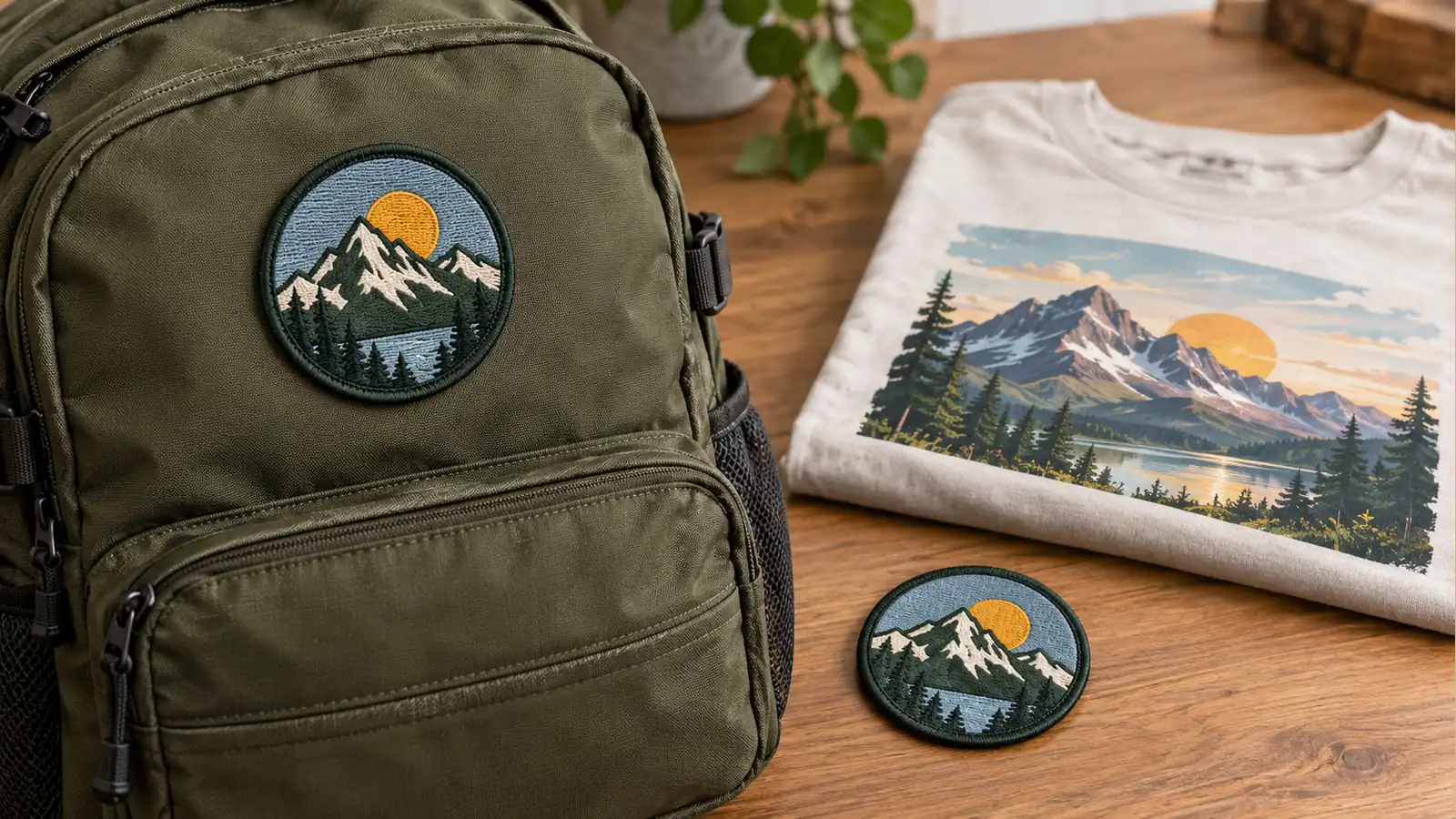
Cover illustration note: Supplied illustration of a stitched badge on a bag beside a printed garment graphic. It does not verify the attachment method, printing process or performance.