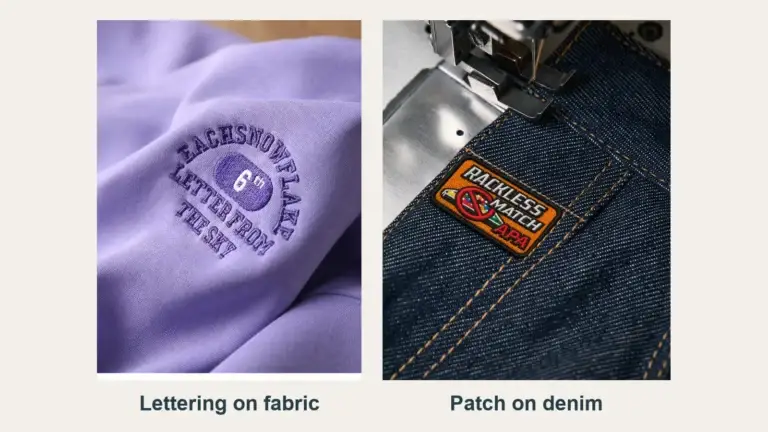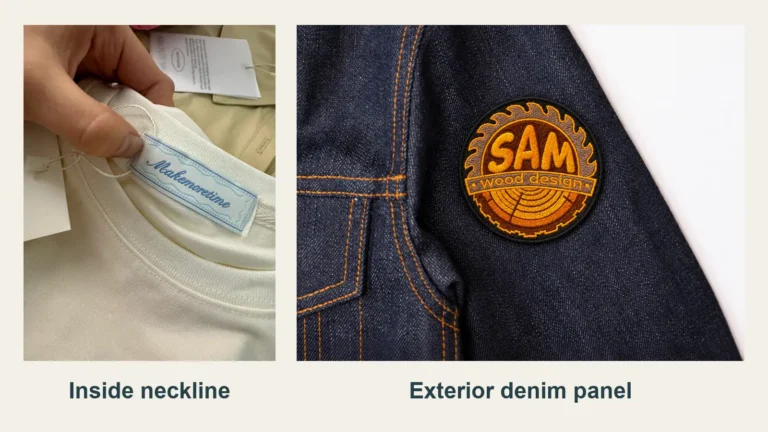

Start with metallic accents when a logo needs one focal point. Choose a metallic outline when its silhouette should catch the light while the interior stays quieter. Consider broad metallic coverage when the reflective surface is central to the design, and approve it on the intended fabric at the final size. There is no universal rule that metallic thread belongs only in small details.
The useful comparison is between specific thread products and three clearly marked design options. A gold color alone does not identify metallic thread, and a bright photograph cannot establish wash resistance, production reliability or the feel of the finished embroidery.
Gold color, ordinary sheen and metallic effect are different choices
Here, standard embroidery thread means the ordinary polyester or rayon thread selected for the project. It does not mean a matte finish: regular embroidery threads can also be lustrous. A gold-colored regular thread can give a logo warmth without reproducing the particular reflection of a metallic product.
Metallic embroidery threads are a varied group. Madeira's FS metallic thread information describes several constructions, including different cores and metallised coverings. The family name alone is therefore too broad for a production specification. Record the manufacturer, series, thread size and shade code, then judge the actual sewn result.
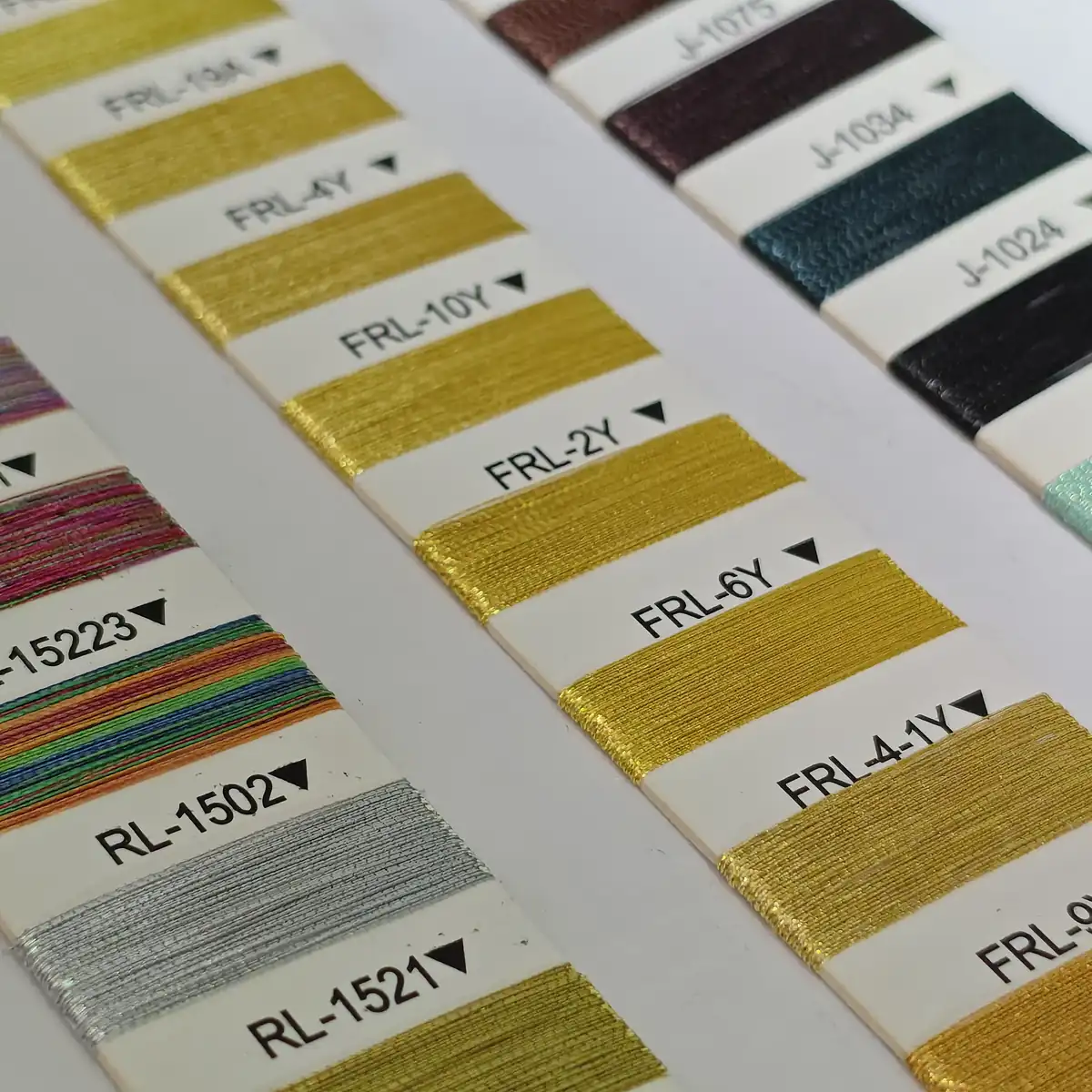
The supplied thread-card image below shows several gold-toned shades beside other colors. It is useful for noticing differences within “gold”; it does not establish which manufacturer or series was used in any of the other pictures. For the wider process of approving a brand shade, see our guide to matching embroidery thread to Pantone colors.
Compare three metallic placements on the same logo
Keep the logo's dimensions, position and component shapes consistent while deciding where metallic thread belongs. Mark each region as metallic or regular thread; do not send only an instruction to “make it gold.” If the design needs simplification for sewing, save that as a separate artwork revision.
The diagram uses one fictional leaf emblem to make the allocation clear. Gold identifies the planned metallic regions, while gray identifies regular thread. These flat colors do not simulate actual shine or stitch texture.
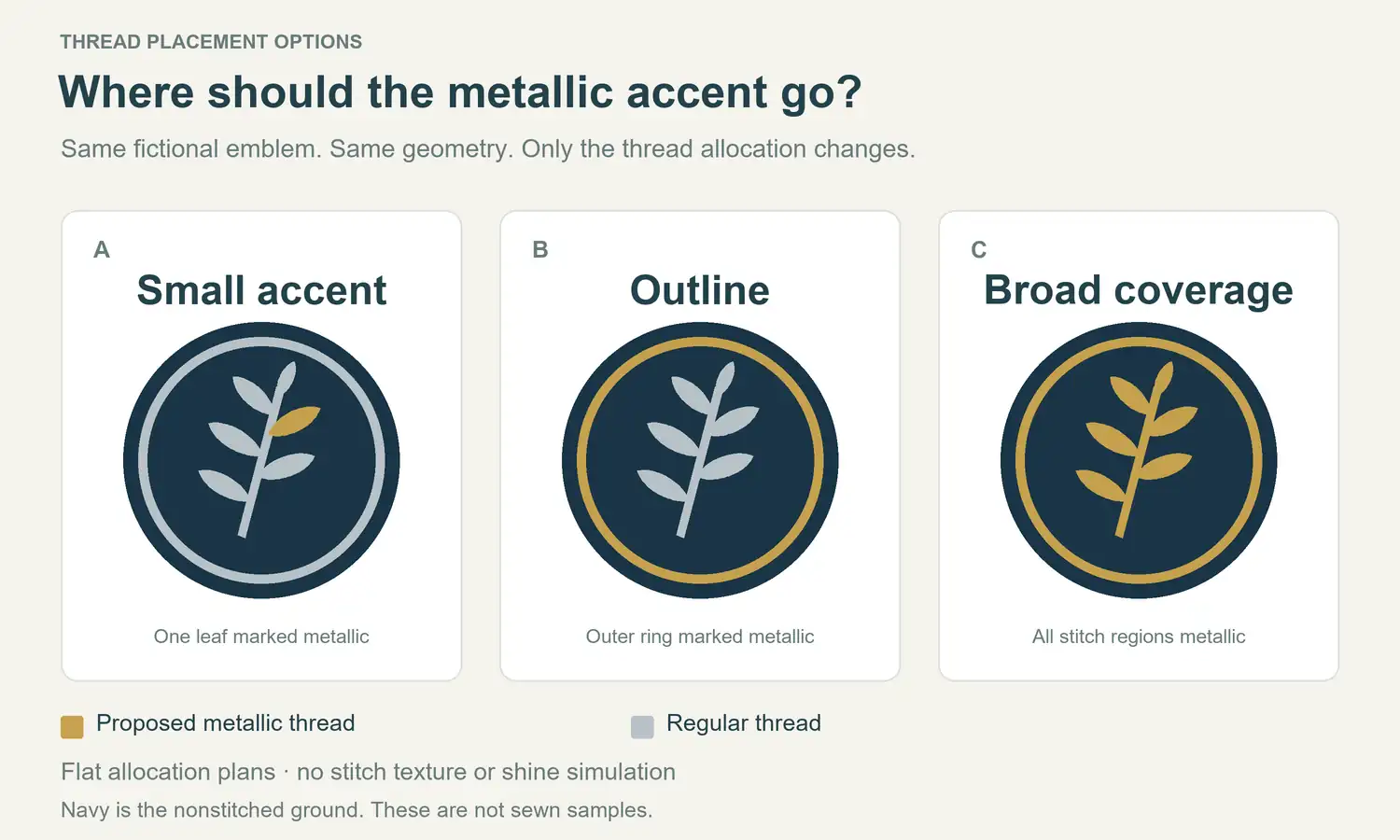
| Placement | Visual purpose | What to resolve in sampling | A reason to reconsider |
|---|---|---|---|
| Small accent | Draw attention to one leaf, symbol or letter detail | Whether the accent remains visible at the final size and gives enough contrast against neighboring thread | It disappears at normal viewing distance or competes with the main wordmark |
| Outline | Emphasize the silhouette while retaining a quieter interior | Continuity around curves, corners and narrow sections; how the edge looks as the product moves | Glare obscures the contour, or the line needs a different stitch treatment to remain clear |
| Broad coverage | Make metallic reflection a main surface feature | Fill direction, joins, detail separation, fabric response and the feel of the finished area | The name loses readability, or the result feels unsuitable for the intended product |
These are design starting points, not a ranking of quality or durability. A long, intricate outline may need more development than a compact fill. The number of thread colors, color changes, stitch paths and revisions also matters; “less metallic area” is not enough to predict the quotation.
Metallic allocation is also separate from total embroidery coverage. A fully embroidered patch can mix regular and metallic thread. Conversely, a sparse line design can use metallic thread for every visible stitch.
Compare the sewn appearance under consistent conditions
Use a regular-thread version as a visual baseline if you need to decide whether the metallic effect adds value. The regular gold shade and metallic gold shade will not necessarily be exact color matches, so label both rather than treating them as interchangeable.
For an initial comparison, use the same fabric, finished size, location and viewing setup. Compare the designs face-on in ordinary room lighting, then tilt them under the same light. Look for a stable reading of the logo as well as the brighter highlights. A short video can help show changes that a single photograph misses.
Judge the intended viewing distance too. A tiny sparkle that looks striking in a close-up may contribute little on a cap worn across a room. Broad reflective lettering may look effective from a distance but lose a narrow internal gap when viewed at another angle. Those are questions for the particular sample, not guaranteed effects of either thread category.
Different motifs, backgrounds or lighting prevent two attractive pictures from serving as a controlled metallic-versus-regular thread trial. Compare labeled physical samples when the finish is part of the purchasing decision.
What changes in digitizing and sample development?
Changing thread may require a different stitch plan. Madeira's metallic guidance includes product-dependent handling recommendations, rather than one machine setting for every metallic thread. Have the embroiderer check the selected product's technical instructions and test its needle, tension and stitch requirements on the actual material. Do not prescribe a universal speed reduction or assume that adding density will improve the shine.
For a small accent, check transitions into neighboring regular-thread areas and whether the detail stays distinct. For an outline, check starts, stops and direction changes. For a broad area, inspect the way adjacent stitch sections reflect light, the visibility of joins and any distortion of the fabric. Thread direction is part of the visual result, not simply a way to fill a shape.
Ask the sample maker to record any problems that actually occur, such as thread breaks, exposed gaps, untidy transitions or puckering, along with the changes made to address them. An image of a good-looking sample does not reveal its run history. Equally, a problem in one setup does not prove that every metallic thread is unsuitable for production.
Choose the most promising allocation before commissioning further versions. If all three remain realistic candidates, request separately identified samples so feedback cannot be confused. Our guide to custom patch samples before bulk production explains how to keep the approved sample and revision record connected to the order.
Specify care before approving the finish
Do not assign a wash temperature, bleach allowance or durability claim from the words “metallic” or “standard.” Check the exact thread product against the intended washing, drying, pressing, dry-cleaning or finishing process. The base fabric, backing, adhesive and any other decoration must also suit that process.
Manufacturer information illustrates why specificity matters. Coats publishes a Sylko Metallic product information sheet with construction and care information for that range. Such information helps select a candidate; it does not certify a finished patch made with an unidentified thread.
Write the intended care process into the sample brief and agree how the decorated product will be checked before bulk approval. If care performance is a purchasing condition, request results for the agreed sample and procedure. A new sample's shine cannot demonstrate how it will look after repeated use or cleaning.
Send a marked thread plan for sampling
A useful brief lets the supplier evaluate a definite design rather than guess how much metallic effect you want. Include:
- The artwork revision and final embroidery dimensions, with every metallic region marked.
- The regular-thread baseline and the accent, outline or broad-coverage option you want assessed.
- The intended product, fabric and position, plus backing or attachment requirements where relevant.
- Any specified thread manufacturer, series and shade code; ask which alternatives are available if the choice is still open.
- The intended care process and the appearance, readability and feel you need to approve.
- Quantity and variants, with a request to record sample revisions and any production adjustments.
For a patch project, review the custom embroidered patch options and send YQX the marked artwork and application details. Ask for confirmation of the proposed thread series and sample scope before treating a metallic finish as part of the order specification.
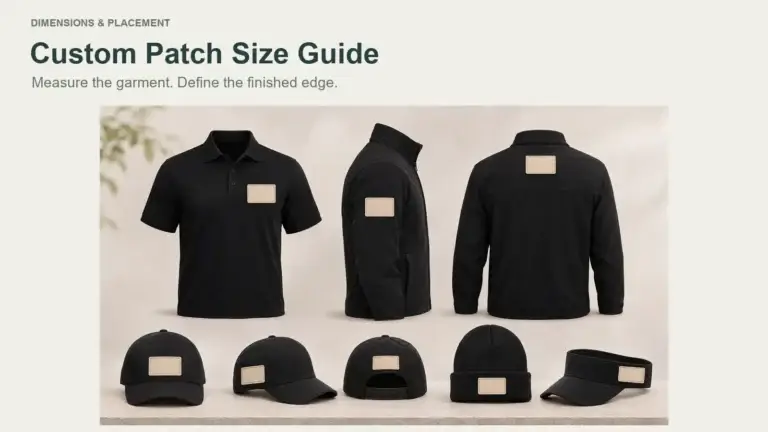
Cover: supplied apparel and cap application illustration, used as a design reference. Thread identity, image creation method, manufacturing origin, care performance and production suitability are not verified by the image.