A custom patch lead time is useful only when you know where its clock starts and ends. A production estimate may begin after approval and finish when the patches are ready to ship. Your launch needs more: time for artwork, sample review and changes, shipment, receipt checks and any attachment to garments. Ask for an order-specific schedule tied to the date the patches must be ready to use.
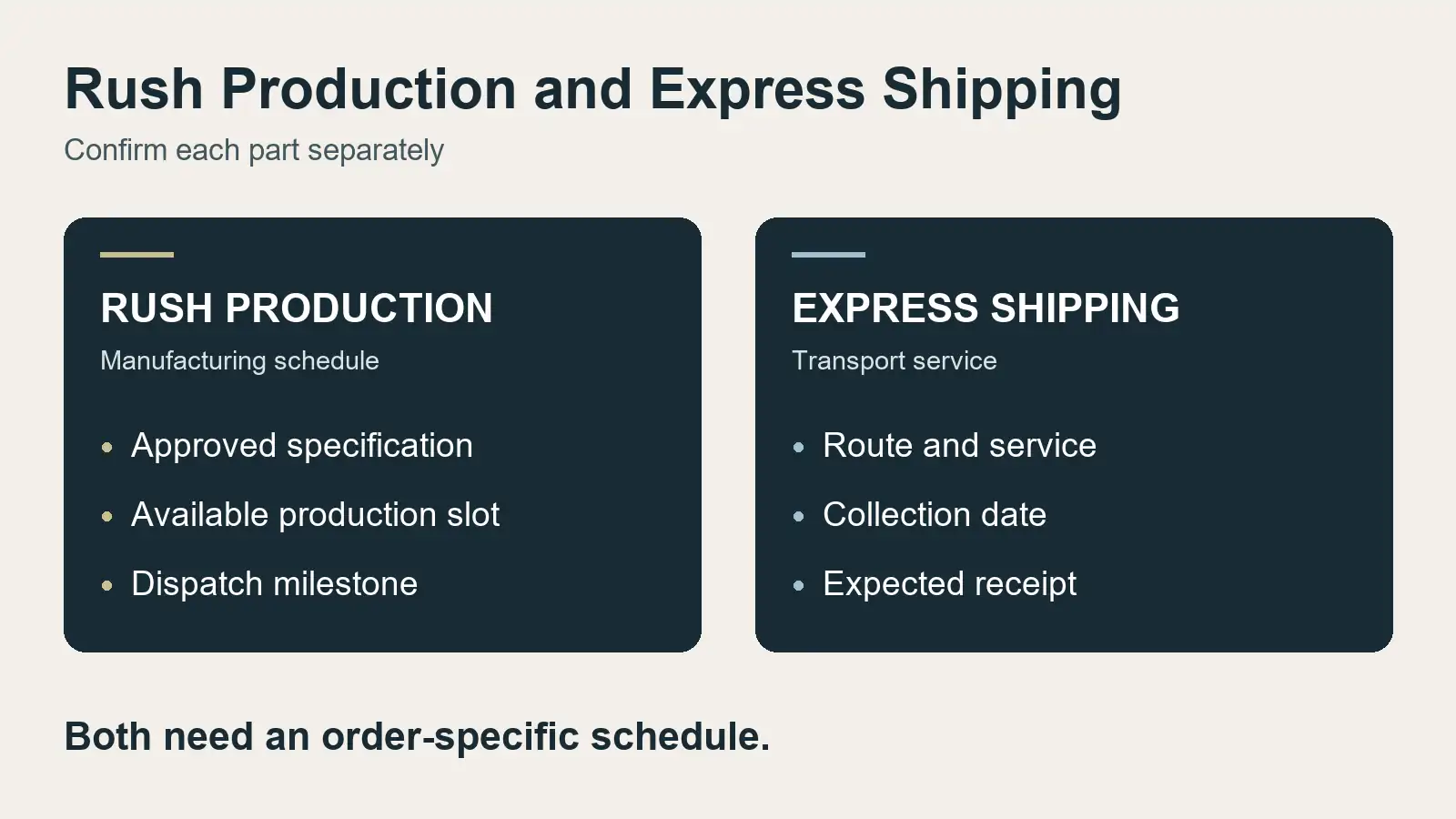
For a deadline order, work backward from when the patches must be ready to use. Confirm the approval cutoff, production release, dispatch and expected receipt separately. Rush production and express shipping solve different parts of the schedule; neither removes the need to agree on the finished specification.
What Does the Quoted Lead Time Include?
Confirm the quotation's starting conditions and endpoint.
World Emblem's FAQ describes production excluding shipping, conditional on order and sample approval. These are its own terms.
Agree business or calendar days, the working calendar, cutoff and time zone, including relevant closures.
Use distinct milestone names. Ready to ship means the order is prepared for dispatch. Dispatched means it has been handed to the transport service. Received means it has arrived at the named location. Ready to use also allows for your inspection, allocation or garment work. Request the milestone that your project actually needs.
Separate Artwork, Samples and Production Release
A digital proof, a photograph of a stitched sample and a physical sample delivered to you are different review arrangements. State which you require and what it must establish. A screen image helps review layout; it cannot establish hand feel or confirm an attachment trial on your actual fabric.
Stadri's ordering process separates artwork and sewn-sample review. It also describes circumstances in which its sample-photo stage may be omitted. This makes an important question for a deadline order: which approval steps does the proposed service include? Agree the review method before accepting the schedule.
Nominate one person to return a consolidated decision. Agree a review window for each proof or sample and identify the exact revision being approved. Separate an approval from a request for changes; a message that approves the color but changes the size does not settle the complete specification.
If the sample needs a correction, ask whether the work requires a revised proof, another stitch-out, another physical shipment or renewed application testing. Reconfirm the affected dates before releasing the revised version. Keep the latest accepted artwork, dimensions, colors, border, backing and quantity together so that an older file cannot be mistaken for the approved order.

Build a Reverse Schedule from the Launch
Start with where the patches must be usable. If a garment factory needs them before assembly, the factory's receiving date comes before the retail launch. If a distributor must sort event packs, its packing deadline matters more than delivery to your office.
Work backward using the actual durations and dependencies supplied by each party. The table below is a planning worksheet, not a standard service timetable. Put an agreed date and owner against each relevant milestone.
| Milestone, working backward | What must be allowed for | Who confirms it | Record to keep |
|---|---|---|---|
| Launch or issue date | Finished garments, packed kits or stock ready for sale | Brand or event team | Final use date and location |
| Patches ready to use | Receiving checks, attachment, packing and allocation, where needed | Receiving or garment team | Latest date patches must be ready to use |
| Receipt at the named address | Selected transport service, destination handling and clearance arrangements | Supplier, carrier and receiver | Expected receipt and its conditions |
| Dispatch | Finished quantity, inspection, agreed packing and collection | Supplier | Dispatch target and collection arrangement |
| Production release | Accepted specification, required approvals, materials and an available production slot | Buyer and supplier | Release conditions and latest approval date |
| First review and any revision | Artwork preparation, the agreed sample method and buyer responses | Buyer and supplier | Review owners, revision allowance and decision dates |
Build the first version together rather than subtracting a supplier's production figure from the event date. Ask which tasks can run in parallel and which cannot start until another is finished. For example, preparing a shipping address can happen during sample review; an unresolved backing choice may prevent approval of the construction.
Include contingency for the unresolved parts of your order. A new attachment method, several internal approvers or a physical sample travelling between countries creates different planning needs from an unchanged repeat order. Agree the allowance instead of applying a universal buffer to every project.
For a repeat order, identify the previous approved version and confirm that the specification and materials remain available. A retained file may reduce development work, but it does not reserve production capacity or establish a delivery date for the new quantity.
What Can Rush Embroidered Patches Actually Change?
World Emblem's rush service depends on approved, converted designs, product eligibility and daily capacity. Confirm acceptance.
For rush embroidered patches, compare standard and accelerated plans for the same specification and address. Confirm approval steps, dispatch, expected receipt and separate production or shipping charges.
| Proposed change | What to confirm before agreeing |
|---|---|
| Faster buyer review | Named approver, available review times and a clear decision cutoff |
| Production priority | Eligible design and materials, confirmed capacity and the stage being shortened |
| Faster transport | Exact service, route, collection date and expected arrival at the required address |
| First shipment before the balance | Quantity and designs in each shipment, separate dates, packing and added cost |
Keep required quality checks in the agreed plan. Ask how the supplier will preserve the approved construction, inspection and traceability within the proposed schedule. If the plan changes the sampling arrangement, approve that change explicitly rather than discovering it after production.
If the full order cannot support the deadline, discuss a smaller first delivery, fewer initial variants or a revised launch scope. Each alternative needs a new feasibility and cost confirmation; splitting an order does not automatically make it faster. Express shipping also cannot recover a late production release before the patches exist.
Plan International Shipping Through to Receipt
Ask for the dispatch location, destination postal code, named receiving contact and selected transport service. Clarify who coordinates the shipment, supplies the commercial information and answers a request for missing information. Check the receiving site's opening hours or event delivery restrictions before booking.
FedEx's shipping glossary distinguishes an estimated delivery window from a guaranteed arrival. Use the carrier's current estimate to plan, and check the actual service terms for any separate commitment. Track collection and subsequent movement; a label or tracking number alone does not establish carrier handoff.
DHL Express's customs guidance explains that clearance may begin while goods are moving. It also identifies incomplete information, slow responses and unresolved payment issues as potential causes of delay. Prepare accurate shipment information and a reachable response owner for the actual route. Do not add a fixed, universal clearance period or count an overlapping activity twice.
When the expected arrival changes, compare it with the date the patches must be ready to use. Ask the supplier and carrier what remains achievable, then update the garment or event team. Faster production does not remove destination requirements, and an earlier dispatch still needs a workable route to the correct receiver.

Give YQX the Deadline and the Dependencies
For a project-specific schedule, send YQX the design, finished size, quantity by design, intended fabric, border and backing requirements. Include the launch date and the earlier date the patches must be available to the team that will use them. The embroidery quotation checklist covers the wider specification brief.
Add the receiving address and postal code, whether you need a physical sample or an agreed photo review, who can approve it, and any attachment or packing work after arrival. If artwork is still changing, use the sampling artwork guide to prepare one clear review version.
Ask for a reply that distinguishes:
- The information and approvals needed to release the order, with decision cutoffs and time zones.
- The proposed sample, revision, production and dispatch milestones.
- The transport service and expected receipt date, including the assumptions still to be confirmed.
- Whether an accelerated option is available, which stage it changes and its additional cost.
Review YQX's custom embroidered patch options, then send the project brief for an order-specific feasibility discussion. Use the written schedule for the accepted specification; a general website turnaround is not a confirmed slot for a new launch.
Featured image note: Editorial cover using a supplied scheduling illustration; the scene does not represent a confirmed order schedule.